As we know, American Bullies are a fascinating breed of dog, known for their muscular build, loyal temperament, and unique coat colors. These dogs come in a wide variety of colors and patterns, from solid black to blue brindle to tri-color. Understanding the genetics behind these colors can help breeders produce desired color combinations and help owners appreciate the unique beauty of their dogs.


In this article, we will explore the genetics behind coat color in American Bullies, including the genes responsible for solid vs. patterned coats and the genes responsible for specific coloration.
Understanding Coat Color Inheritance
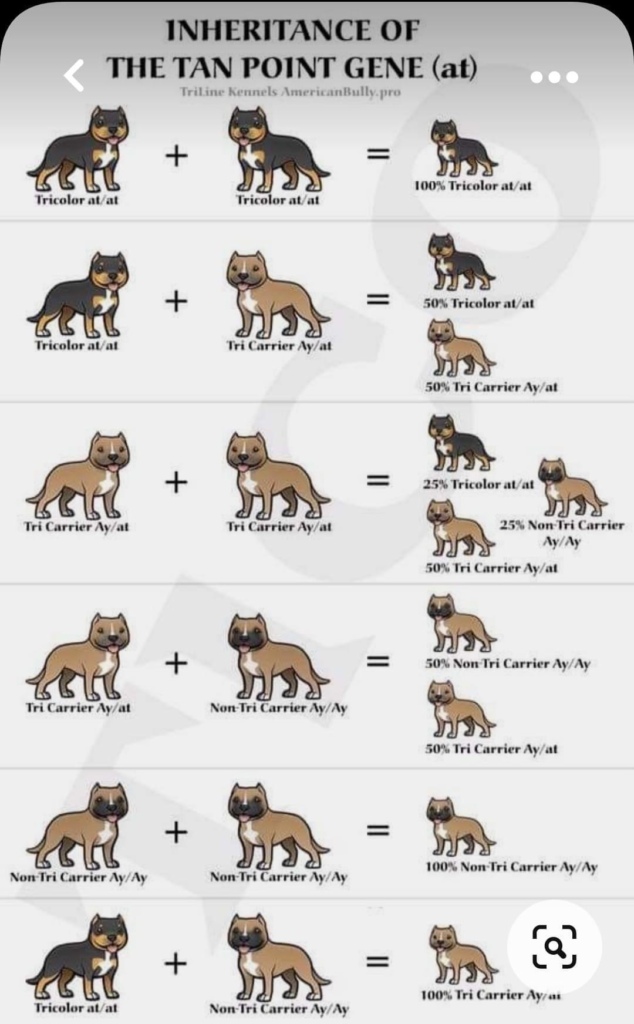
Before we delve into the genetics of coat color in American Bullies, let’s first review how genes are passed down from parents to offspring. Dogs have two copies of each gene, one inherited from their mother and one inherited from their father. Each gene can have different variations, known as alleles. When a dog inherits two copies of the same allele (homozygous), they will exhibit that trait. When a dog inherits two different alleles (heterozygous), one allele will usually be dominant and the other recessive, and the dominant allele will determine the dog’s appearance.
Take a look at this illustration by TriLine Kennels at AmericanBully.pro:
Now, let’s apply this concept to coat color in American Bullies. There are two main genes that determine coat color: the E locus and the K locus.


The E Locus
The E locus determines whether a dog has a solid coat color or a patterned coat color. There are two alleles for this gene: E, which produces a solid coat color, and e, which produces a patterned coat color. The E allele is dominant over the e allele, which means that a dog with one E allele and one e allele will have a solid coat color.
However, dogs that have two copies of the recessive e allele (ee) will have a patterned coat color. The pattern can range from brindle, which is a striped pattern, to piebald, which is a pattern of white and another color.
The K Locus
The K locus determines the intensity of a dog’s coat color. There are three alleles for this gene: K, kbr, and ky.
The K allele produces a full range of color options, from black to white and everything in between. This allele is dominant over the other two alleles, which means that dogs with one K allele and one kbr or ky allele will have a full range of color options.


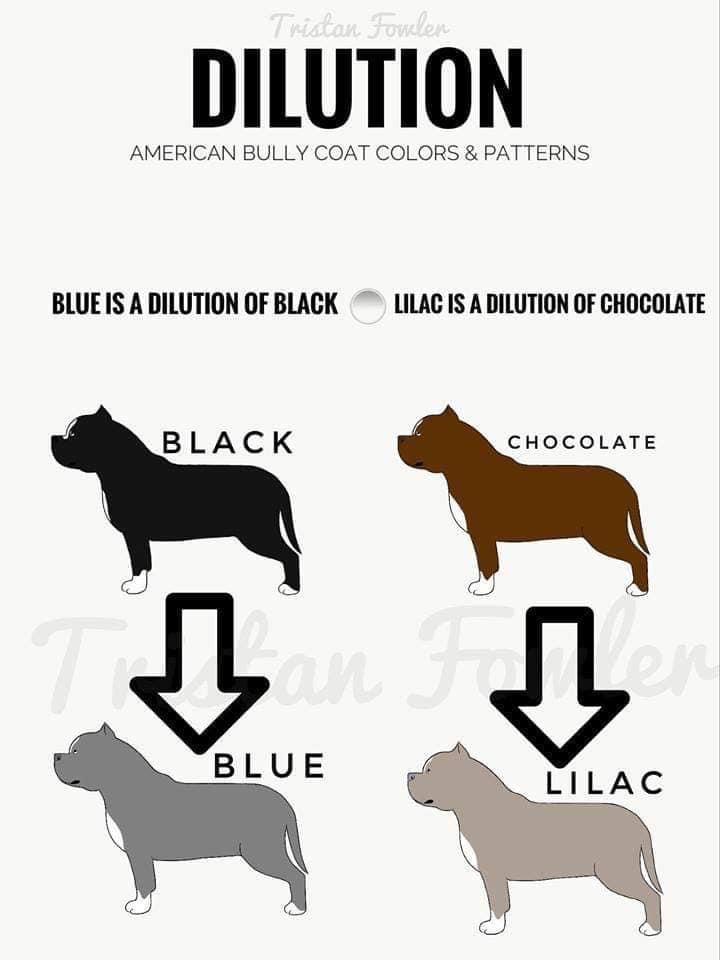
The kbr allele produces a darker shade of color. Dogs with two copies of this allele (kbrkbr) will have a dark coat color. This allele is often associated with black, chocolate, or blue coat colors.
The ky allele produces a lighter shade of color. Dogs with two copies of this allele (kyky) will have a light coat color. This allele is often associated with cream or fawn coat colors.
Check out these illustrations by Tristan Fowler:


Other Genes That Affect Coat Color
While the E and K loci are the two main genes that determine coat color in American Bullies, there are several other genes that can affect coat color. These genes can produce variations in coat color intensity, patterning, and shading.
For example, the A locus, which is responsible for producing black pigment, can affect the intensity of coat color. Dogs that have two copies of the dominant A allele (AA) will have the darkest coat color, while dogs that have two copies of the recessive allele (aa) will have a lighter coat color.
Likewise, the S locus is responsible for producing white pigment, which can affect the amount of white in a dog’s coat. Dogs that have two copies of


the dominant S allele (SS) will have a solid coat color, while dogs that have two copies of the recessive s allele (ss) will have a significant amount of white in their coat.
The G locus is responsible for producing gray pigment, which can affect coat color in dogs that have the dilute gene (dd). Dogs that have two copies of the dominant G allele (GG) will have a normal coat color, while dogs that have two copies of the recessive g allele (gg) will have a diluted coat color, often referred to as blue or silver.
The B locus is responsible for producing brown pigment, which can affect coat color in dogs that have the liver gene (bb). Dogs that have two copies of the dominant B allele (BB) will have a black or dark coat color, while dogs that have two copies of the recessive b allele (bb) will have a brown coat color.


Putting It All Together
“The most colorful thing in the world is black and white, it contains all colors and at the same time excludes all.“-
Vikrmn, 10 Alone
Now that we understand the basics of coat color inheritance in American Bullies, let’s take a closer look at how these genes can combine to produce specific coat colors and patterns.
For example, a dog that has two copies of the E allele (EE) will have a solid coat color, while a dog that has two copies of the e allele (ee) will have a patterned coat color. If that same dog also has two copies of the K allele (KK), they will have a full range of color options.


On the other hand, a dog that has two copies of the kbr allele (kbrkbr) will have a dark coat color, while a dog that has two copies of the ky allele (kyky) will have a light coat color.
When we combine these genes, we can create a wide variety of coat colors and patterns. For example, a dog that has one copy of the E allele and one copy of the e allele (Ee) can produce both solid and patterned offspring. If that same dog also has one copy of the K allele and one copy of the kbr allele (Kkbr), they can produce offspring with a full range of colors, including black, chocolate, and blue.
Similarly, a dog that has one copy of the E allele and one copy of the e allele (Ee) and one copy of the K allele and one copy of the ky allele (KKy) can produce cream or fawn colored offspring.


In compendium, the color genetics of American Bullies can be complex, but understanding these genetics can help breeders produce desired color combinations and help owners appreciate the unique beauty of their dogs. By understanding the basics of coat color inheritance and the role of genes such as the E locus and the K locus, we can better appreciate the wide variety of coat colors and patterns seen in American Bullies.